
How to Choose the Best Study Abroad Program: US, UK, Canada, Australia Compared
Choosing where to feels like standing at a crossroads with endless possibilities ahead. Many students wonder whether they should pick the UK or Canada, while others dream about the US despite its steeper price tag.
The latest numbers paint an interesting picture. The United States attracted more than 950,000 international students during 2022-2023. The UK’s educational excellence shines through with 90 universities in the QS World Rankings, and four of them rank among the world’s top ten. Both countries deliver outstanding education, but their costs differ substantially. American universities ask for $20,000 to $80,000 each year, while UK programs cost between £9,000 and £25,000 annually. Students looking for better value often turn to Canada, where yearly tuition runs from $10,000 to $25,000 CAD. Australia stands out as another great option, especially when you have interests in engineering and medicine, thanks to its research facilities and hands-on experience.
This detailed guide dives into these four popular destinations beyond their academic standings and fees. You’ll learn about work permits after graduation – with Canada’s generous three-year work authorization. We’ll also cover education standards, daily expenses, and paths to immigration that will help you make this important decision with confidence.
Education Quality and Course Duration
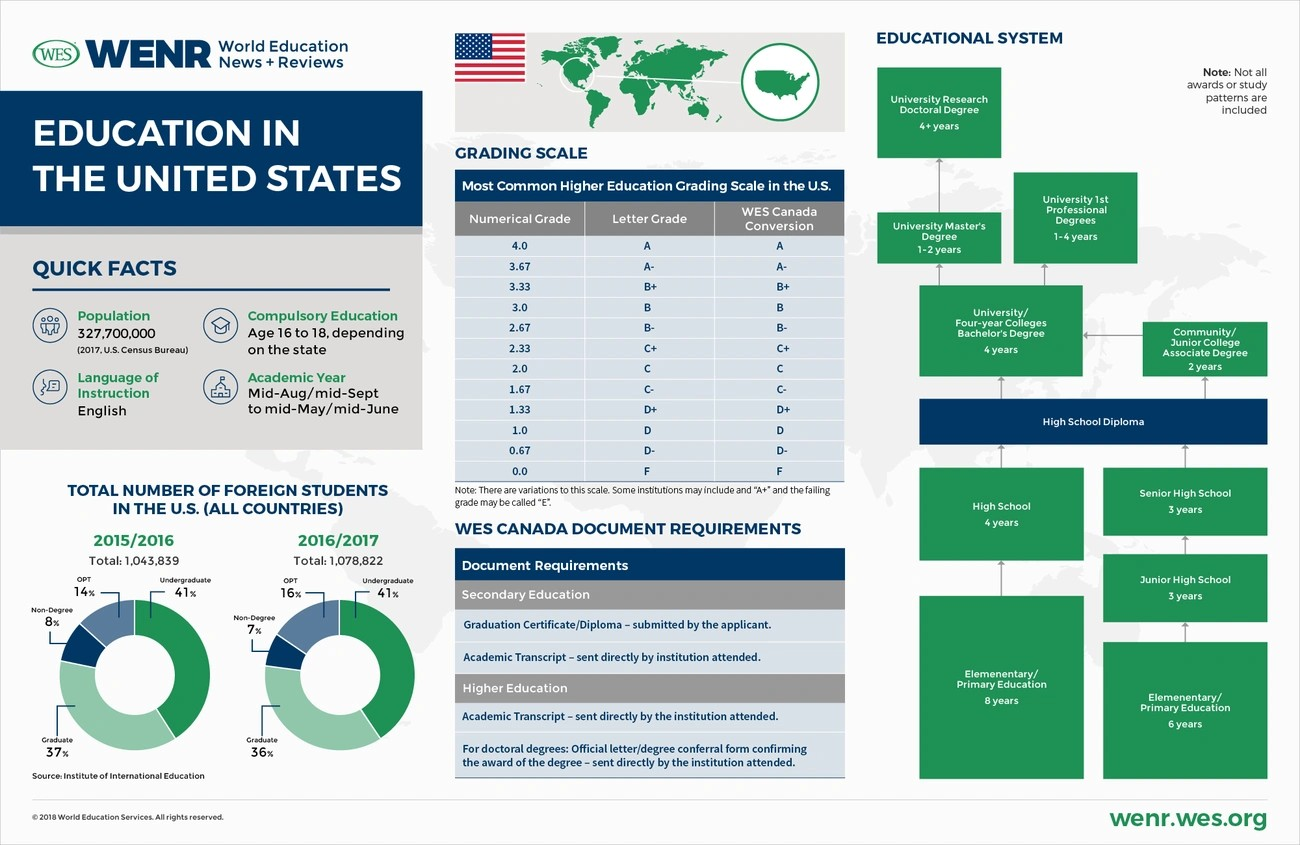
A country’s academic standing plays a key role in attracting international students. The structure and length of degree programs can make a big difference in choosing where to study.
Education system in the US, UK, Canada, and Australia
These four countries each take their own approach to higher education. Their teaching methods and program structures set them apart.
The United States has one of the most diverse education systems with about 4,000 accredited universities. American schools let students explore different subjects before picking their major. Students spend their first two years studying general topics. This broad foundation helps them learn about sciences, engineering, and business.
British education takes a different path. Students focus on their chosen field right from the start. Programs help students master business, law, and sciences quickly. The British Council says UK courses “tailor-made to support you in getting the most from your studies as quickly as possible”. This focused approach helps students finish their degrees faster than other countries.
Canadian schools blend the best of US and UK systems. They mix theory with hands-on practice. Many international students feel at home here. Top schools include the University of Toronto, University of British Columbia, and McGill University.
Australian universities shine in engineering, medicine, and environmental sciences. Six Australian schools rank among the world’s top 100. Students get both classroom learning and practical experience. This mix draws many students looking to build real-world skills.
Top universities in each country
The show the best schools in these countries.
American universities lead the world rankings. Harvard University tops the list with a perfect Global Score of 100.0. MIT follows at 97.2, and Stanford University at 94.5. Other top US schools include UC Berkeley (86.4), Yale University (86.0), and Columbia University (85.8).
British universities pack a punch despite the country’s small size. The University of Oxford has held the top spot for nine straight years. Oxford (88.3) and Cambridge (86.8) lead British education, with University College London (86.2) close behind. The UK has 90 universities in the QS World University Rankings.
Canada shines with schools like the University of Toronto, University of British Columbia, and McGill University. These schools mix high-quality teaching with practical training.
Australian schools draw international students with their STEM and healthcare programs. The University of Melbourne, University of Sydney, Monash University, and Australian National University stand out in these fields.
Course duration comparison
Time matters when picking where to study. Here’s how long it takes to earn degrees in each country.
| Country | Undergraduate | Master’s | PhD |
| USA | 4 years | 1-2 years | 4-6 years |
| UK | 3 years (4 in Scotland) | 1 year | 3-4 years |
| Canada | 3-4 years | 1-2 years | 4-6 years |
| Australia | 3-4 years | 1-2 years | 3-4 years |
UK degrees take the least time. Students finish their bachelor’s in three years, except in Scotland where it takes four. Most master’s programs wrap up in just one year. Students can start working sooner and spend less on education.
US bachelor’s degrees always take four years, with 120-128 semester credit hours. Master’s programs usually last two years, though some professional courses might differ. PhD programs run longer, often taking 4-6 years.
Canada and Australia offer more options. Bachelor’s degrees range from three to four years based on whether students choose general or honors programs. Master’s degrees take 1-2 years. PhDs last 3-4 years in Australia and 4-6 years in Canada.
Which country offers the most flexible programs?
Students have different options to shape their education in each country.
US schools give students the most freedom. They can mix subjects through “major/minor” combinations. Many schools let students stay “undeclared” for their first two years. This gives them time to explore before picking a focus.
British universities want students to pick their program before starting. Changing direction later isn’t easy. But schools offer some choices within each field. The British Council says “flexibility is built into the majority of our courses. Many universities allow you to choose from different subject ‘modules’, so you can build a course program that suits you down to the ground”.
Canadian schools mix both approaches. Students pick their program early but can often change majors or take diverse courses. CO-OP programs give Canada an edge. Students can switch between classes and paid work terms.
Australian schools work like Canadian ones, plus extra options. Students can add honors years, research projects, and work experience. Three-year bachelor’s degrees can stretch to four years with honors work. This can lead straight to PhD studies, skipping the master’s degree.
Indian students choosing between the UK and Canada face a trade-off. UK programs finish faster and focus deeply on one subject. Canadian schools let students explore more and gain work experience during their studies.
Tuition Fees and Cost of Living
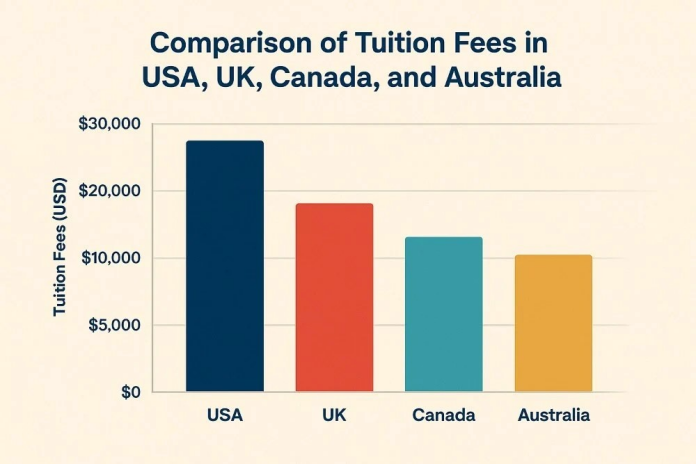
Financial planning is the foundation of any study abroad decision. The cost of education plays a crucial role in choosing your destination country, right alongside academic quality and course structure.
Tuition fees in the US, UK, Canada, and Australia
Each country has its own fee structure that varies by a lot based on programs and institution types.
The United States leads the pack as the most expensive study destination. Public universities charge international students between INR 1,687,609 to INR 2,953,315 yearly, while private institutions ask for more than INR 4,219,022 each year. Graduate programs cost between INR 1,687,609 to INR 3,375,218 per year. Medical school fees are a big deal as it means that they can exceed INR 5,062,827 yearly.
British education comes with a moderate price tag. International students pay between £10,000 to £38,000 (approximately INR 1,000,000 to INR 3,800,000) yearly for undergraduate programs. Postgraduate courses cost between £12,000 to £40,000 per year. Schools in London charge premium fees, which can reach £25,000 yearly for specialized programs like medicine and engineering.
Canada stands out as a budget-friendly option. International undergraduates pay between CAD 7,000 to CAD 29,000 (approximately INR 420,000 to INR 1,740,000) yearly. Master’s programs range from CAD 8,000 to CAD 35,000 per year, and top MBA programs can reach CAD 50,000 annually.
Australia sits in the middle range. Undergraduate programs cost between AUD 20,000 to AUD 45,000 (approximately INR 1,000,000 to INR 2,250,000) yearly, while postgraduate programs range from AUD 22,000 to AUD 50,000 per year. Medicine and veterinary science programs come with premium price tags.
Living expenses in major cities vs smaller towns
Your choice of location can affect your monthly budget dramatically.
American metropolitan areas like New York and San Francisco ask for INR 843,804 to INR 1,518,848 yearly for accommodation, food, and transportation. You can save 30-40% by choosing smaller cities and college towns.
The UK shows a clear difference between London and regional cities. Living in London costs about £15,000 (INR 1,500,000) yearly, while cities like Manchester or Birmingham are 30-40% cheaper at around £10,000 (INR 1,000,000) per year.
Canadian cities like Toronto and Vancouver need CAD 10,000 to CAD 15,000 (approximately INR 600,000 to INR 900,000) yearly. Smaller towns in Manitoba or Saskatchewan offer much lower living expenses, making them popular among students watching their budgets.
Australian cities Sydney and Melbourne ask for AUD 21,000 to AUD 29,000 (approximately INR 1,050,000 to INR 1,450,000) yearly for simple living. Regional areas like Adelaide or Perth can help you save 15-25%.
Students in smaller cities benefit from lower living costs. Everything from rent to food, transportation, and entertainment costs less than in major cities. This lets students focus more on their studies and worry less about money.
Which country is most affordable overall?
Looking at total costs (tuition plus living expenses), some patterns become clear:
The UK turns out to be surprisingly affordable among the four major destinations. This is mainly because programs are shorter. You’ll spend three years on an undergraduate degree instead of four in the US, saving a full year’s tuition and living costs. Master’s programs also take just one year compared to two elsewhere.
Canada gives you the best value for money. With lower tuition fees than the US and Australia, and cheaper living costs than the UK (especially London), it’s a great option for budget-conscious international students. Indian students also benefit from favorable exchange rates.
Australia and the US are the pricier options. While Australian tuition might be lower than American fees, its location means higher travel costs and fewer chances to visit home.
This comparison table shows the approximate yearly total cost (in INR) for international students:
| Country | Undergraduate (Annual) | Postgraduate (Annual) |
| USA | 2,531,413 – 5,062,827 | 2,953,315 – 5,062,827 |
| UK | 2,000,000 – 3,800,000 | 2,200,000 – 4,000,000 |
| Canada | 1,415,936 – 2,026,992 | 1,497,246 – 2,311,771 |
| Australia | 2,602,293 – 3,543,978 | 1,687,609 – 3,122,076 |
Hidden costs to think about
Students often overlook several expenses beyond tuition and housing:
Health insurance is mandatory in most countries. You’ll pay between INR 42,190 to INR 168,760 yearly depending on where you study. American insurance costs INR 100,000 to INR 150,000 yearly, while British schools ask for an Immigration Health Surcharge (about £470 or INR 47,000 per year).
Foreign exchange fees can add up quickly. Banks add 2-4% to the official exchange rate for tuition transfers. This means thousands of extra rupees for each payment.
You’ll also need money for:
- Visa renewal fees and work permits costing between INR 12,000 to INR 45,000 depending on the country
- Academic materials, specialized software, and lab equipment not included in tuition
- Seasonal clothing (especially winter gear in colder countries)
- Return flights during holidays and breaks
- Utilities like electricity, heating, internet, and water
Keep some emergency money handy. Financial experts suggest saving 10-15% of your yearly education budget for unexpected costs.
Part-time work opportunities can help with expenses. Canada and Australia let students work up to 20 hours weekly during term time. The UK has similar rules, while the US limits on-campus work to 20 hours weekly during semesters and 40 hours during breaks.
Post-Study Work and PR Opportunities
Getting a job after graduation is a vital factor for international students choosing where to study. Students look beyond just degree quality and tuition costs. Their decision depends on work rights after graduation and ways to become permanent residents.
Post-study work visa options in each country
Major study destinations give graduates different chances to work, each with its own rules and time limits:
Canada leads with its Post-Graduation Work Permit Program (PGWPP). Graduates can work up to 3 years based on their program length. The open work permit lets them work for any employer in Canada. This flexibility helps graduates build their careers.
Australia gives graduates a Temporary Graduate Visa (subclass 485). They can work 2 to 4 years depending on their qualification. Indian graduates get special benefits through the Australia-India Economic Cooperation and Trade Agreement (AI-ECTA). Bachelor’s graduates get 2 years, STEM honors graduates 3 years, and PhD holders 4 years.
United Kingdom has the Graduate Route visa. Graduates can work or look for jobs for 2 years after their degree. PhD graduates get 3 years. They don’t need job sponsorship or minimum salary requirements, which makes career exploration easier.
United States runs the Optional Practical Training (OPT) program. Students can work for 12 months in their field after graduation. STEM graduates can extend this to 36 months total (12 months regular OPT plus a 24-month STEM extension). Unlike other countries, OPT jobs must relate to the student’s field of study.
| Country | Post-Study Work Duration | Special Features |
| Canada | Up to 3 years | Open work permit with any employer |
| Australia | 2-4 years | Extended periods for STEM and PhD graduates |
| UK | 2 years (3 for PhDs) | No job sponsorship required |
| US | 1 year (3 for STEM) | Must work in field of study |
Pathways to permanent residency
Students who want to settle long-term need to know their options for permanent residency:
Canada has several ways to become a permanent resident through the Express Entry system. The Canadian Experience Class (CEC) needs 12 months of skilled Canadian work experience. This makes the PGWP a great first step. Provincial Nominee Programs (PNPs) give more options, especially to students who studied in specific provinces.
Australia lets graduates become permanent residents through skilled independent visas and employer-sponsored options. Work experience during post-study time adds points to permanent residency applications. Regional visas speed up the process for those who live outside major cities.
United Kingdom graduates can switch from the Graduate Route to the Skilled Worker visa with employer sponsorship. After five years on qualifying visas, they can apply for Indefinite Leave to Remain (ILR) – the UK’s version of permanent residency.
The United States has the toughest path to permanent residency. Most graduates move from OPT to an H-1B visa, which needs employer sponsorship. The H-1B has limited spots each year and uses a lottery system, making results uncertain.
Which country is better for long-term settlement?
Canada stands out as the best place for long-term settlement. It scored 35 out of 45 points in a 2025 global study of study-to-stay destinations. Students can become permanent residents within 5 years of graduation through clear Express Entry paths and provincial programs.
Germany and Mauritius come next with 31 points each. They offer job search visas for at least 18 months and PR tracks that take 5 years. Australia ranks seventh but works great for STEM graduates, with up to 6 years of post-study work rights in regional areas.
The UK’s position for long-term settlement changed after recent policy updates. Graduate routes still give good work experience but make permanent residency more complex.
The United States ranks as “workable” despite its top universities. This lower ranking comes from limited post-study visa options and complex permanent residency processes. The H-1B lottery system makes long-term planning difficult.
Work rights during studies
Students can gain experience and earn money while studying. Each country has different rules for on-campus and off-campus work:
Canada now lets international students work off-campus up to 24 hours weekly without extra permits. This ranks among the best work rights during study periods.
United States F-1 visa holders can’t work off-campus in their first academic year. Later, they can do Curricular Practical Training (CPT), Optional Practical Training (OPT), or STEM OPT extension. All jobs must match their field of study.
Australia lets students work part-time during studies. The United Kingdom also allows part-time work during term time.
Work rights make a big difference when comparing the UK and Canada. Canada gives more work hours during studies and much longer post-graduation work rights. This creates an easier path to permanent residency. Indian students find Canada attractive because it combines good education, reasonable costs, and clear immigration paths.
Scholarships, Admission, and Visa Process
Getting financial support and meeting entry requirements are significant steps in your study trip abroad. Each country has its own scholarship programs and visa routes you should learn about before making your final choice.
Scholarship options in the US, UK, Canada, and Australia
Most international students need extra financial support. US universities offer their own scholarships, and STEM fields give students the best funding options. The Fulbright program is one of the most prestigious choices for international scholars.
Students heading to the UK can find targeted opportunities. The Northcote Postgraduate Scholarship helps UK nationals study in Australia. Indian students can get great support through Commonwealth Scholarships and the Charles Wallace India Trust.
Canadian schools give merit-based scholarships through their international offices. Australian universities give out over INR 11,391.36 million in scholarships each year. The Australia Awards Scholarships help students from developing countries who show leadership skills.
Your test scores can help you get scholarships. Students with good IELTS scores qualify for Hornby Scholarships and British Council IELTS Awards. TOEFL scores help you get ETS scholarships and TOEFL Young Student Series grants.
Admission requirements and language tests
Entry requirements differ between countries, but language skills are vital everywhere. Students usually take IELTS, TOEFL, PTE, or the newer Duolingo English Test.
Basic admission documents you need include:
- Valid passport and academic transcripts
- Statement of purpose or personal essay
- Letters of recommendation
- Financial statements proving sufficient funds
Graduate programs often need standardized test scores. GRE scores help you get into top schools like INSEAD, Chicago Booth, and Stanford. GMAT scores open doors to the world’s best business schools.
Visa application process and timelines
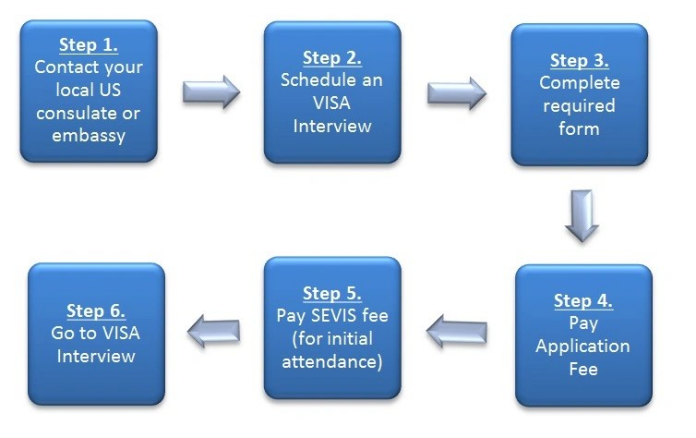
The right timing makes your visa process smoother. US student visas (F-1) are available 365 days before your course starts, but you can only enter 30 days before classes begin. You’ll need to fill out Form DS-160, pay fees, and have a consular interview.
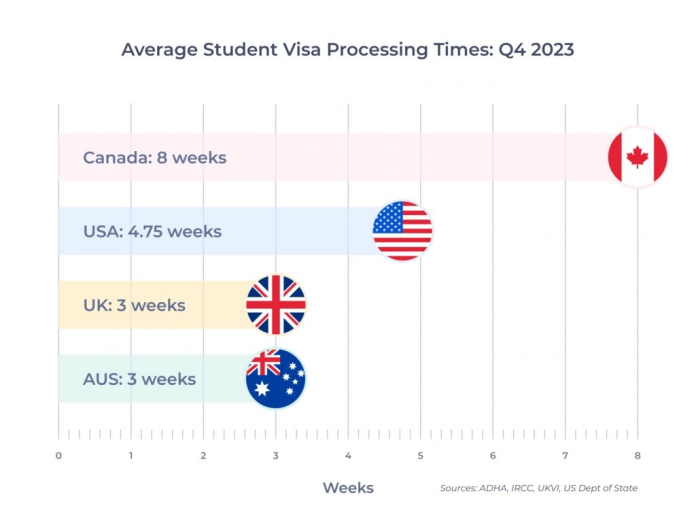
The UK process starts 6 months before your course begins, and decisions usually come within 3 weeks. Canadian study permits need an acceptance letter from a designated school, and you must submit biometrics within 30 days after getting instructions.
Visa costs matter too. UK student visas cost £524 plus healthcare charges. Other countries charge similar fees.
Ease of getting a student visa
Germany leads with 90% visa approval rates for international students. Poland comes next at 95%, and France approves about 85% of applications.
Canada stands out among English-speaking countries with its simple study permit process. Students get clear paths to work during and after their studies.
The UK has made its student visa system easier over the last several years. Students aged 16-17 need parents’ permission, and everyone must prove their English skills and financial stability.
Australia’s Subclass 500 visa takes about four weeks to process. The US system needs more steps, including SEVIS registration, SEVIS I-901 fee payment, and getting Form I-20 from your school.
Canadian study permits are easier to get than UK visas, especially if you want to stay longer after finishing school.
Comparison Table
| Aspect | United States | United Kingdom | Canada | Australia |
| Education Quality & Duration | ||||
| Undergraduate Duration | 4 years | 3 years (4 in Scotland) | 3-4 years | 3-4 years |
| Master’s Duration | 1-2 years | 1 year | 1-2 years | 1-2 years |
| PhD Duration | 4-6 years | 3-4 years | 4-6 years | 3-4 years |
| Education Approach | Liberal arts foundation with flexible major/minor system | Specialized focus from start | Balanced theoretical and practical approach | Strong STEM focus with hands-on learning |
| Tuition & Living Costs (Annual) | ||||
| Undergraduate Tuition | INR 1.68M – 4.22M | INR 1M – 3.8M | INR 420K – 1.74M | INR 1M – 2.25M |
| Living Expenses (Major Cities) | INR 843K – 1.52M | INR 1.5M (London) | INR 600K – 900K | INR 1.05M – 1.45M |
| Post-Study Work Rights | ||||
| Work Permit Duration | 1 year (3 for STEM) | 2 years (3 for PhDs) | Up to 3 years | 2-4 years |
| Work Restrictions | Field of study alignment required | No sponsorship needed | Open work permit | Extended STEM/PhD options |
| PR Pathway Ease | Challenging with H-1B lottery | Moderate with 5-year qualifying visas | Multiple favorable pathways | Strong options in regional areas |
| Admission & Visa | ||||
| Visa Processing Time | Up to 365 days before course | 6 months before course | Standard processing | 4 weeks typical |
| Work Rights During Study | On-campus work first year | Part-time during term | Up to 24 hours weekly | Part-time allowed |
| Language Requirements | TOEFL/IELTS required | IELTS/PTE required | IELTS/TOEFL required | IELTS/TOEFL required |
Conclusion
Picking the perfect means looking at several factors that line up with your academic goals, budget, and future plans. Canada stands out as an attractive choice for students watching their spending. It offers up to three years of unrestricted work authorization after graduation and several paths to permanent residency.
The UK makes an excellent choice if you want efficient programs and prestigious education. Most undergraduate degrees take just three years, and master’s programs only need one year. You’ll save money despite higher yearly costs.
Australia shines with its research opportunities and hands-on experience, especially in STEM fields. PhD graduates can work up to four years after finishing their studies. The country shows its support for international students by offering scholarships worth over INR 11,391.36 million each year.
The US costs the most but makes up for it with academic variety and flexibility. Students can explore different subjects before picking their major. STEM graduates also get extended work permits.
Your financial plan needs extra attention. Health insurance, foreign exchange fees, and seasonal clothing can add up quickly beyond tuition and housing costs. Smart students set aside 10-15% of their education budget for unexpected expenses.
Work rights vary by country. Canada leads the pack by letting students work up to 24 hours weekly during their studies. These jobs help cover living costs and add valuable work experience.
Your best choice depends on what matters most to you. Canada works well for budget-conscious students. The UK attracts those wanting prestigious, quick programs. Australia fits research-focused students perfectly. The US offers the most flexibility but costs more.
The right choice goes beyond rankings and numbers. Your comfort, cultural fit, and career goals matter just as much. Each country offers unique benefits that match different goals differently. Good research and honest self-assessment will help you find the study abroad experience that best fits your academic and professional future.
FAQs
Q1. What are the key factors to consider when choosing a study abroad program?
When selecting a study abroad program, consider academic requirements, language proficiency needed, financial costs, location, housing options, type and size of institution, program dates, and length of study. These factors will help you find a program that aligns with your academic goals and personal preferences.
Q2. How do post-study work opportunities compare between popular study destinations?
Post-study work opportunities vary significantly. Canada offers up to 3 years of work authorization, Australia provides 2-4 years depending on the qualification, the UK allows 2 years (3 for PhDs), and the US grants 1 year (3 for STEM graduates). Canada generally offers the most flexible options for long-term settlement.
Q3. Which country offers the most affordable education for international students?
Among the major English-speaking destinations, Canada often emerges as the most affordable option when considering both tuition fees and living expenses. It offers quality education at lower costs compared to the US and Australia, with favorable exchange rates for many international students.
Q4. How do visa processes differ between study abroad destinations?
Visa processes vary in complexity and timing. The US allows visa applications up to 365 days before course start, the UK opens applications 6 months prior, while Canada and Australia have more standardized processes. Canada’s study permit system is often considered more straightforward, especially for those considering long-term opportunities.
Q5. What hidden costs should students budget for when studying abroad?
Beyond tuition and housing, students should budget for health insurance, foreign exchange fees, academic materials, seasonal clothing, return flights, utilities, and emergency funds. Experts recommend setting aside 10-15% of the annual education budget for unexpected expenses to ensure financial stability throughout the study period.