
IELTS Academic vs General Training: Which Test Matches Your Goals?
Your success in English proficiency tests depends on understanding the difference between academic and general IELTS. The IELTS test comes in two distinct versions that arrange with different life goals. Students pursuing undergraduate or postgraduate education need the IELTS Academic test for university entry. The IELTS General Training version suits people planning to migrate to English-speaking countries[-2].
Both tests measure English language skills with different purposes. Professionals seeking registration in law or medical practice should take the IELTS Academic exam. The General Training version works best for people who want to work abroad or study below degree level. Students often ask us “which IELTS should I take for masters?” The Academic version is the right choice. The biggest problem lies in Reading and Writing sections. Academic tests use university-style materials like journals. General Training focuses on everyday content from newspapers, advertisements, and notices. The Listening and Speaking tests remain similar in both versions. This piece will help you pick the test that matches your goals and requirements.
Purpose of IELTS Academic vs General Training
The main difference between IELTS Academic and General Training shows in their purposes and who they’re meant for. Each version of this respected English test serves specific goals that match different career paths and study plans.
Who should take IELTS Academic?
IELTS Academic stands as the global benchmark to measure English skills in academic settings. This test suits candidates who want to study or register professionally in English-speaking countries.
You should take IELTS Academic if you:
- Plan to study at an undergraduate or postgraduate level in an English-speaking environment
- Need to apply for a Student Route visa to study at a UK university
- Want professional registration in fields like medicine, nursing, engineering, or teaching in English-speaking countries
- Want to show you’re ready to use English for academic study
IELTS Academic checks if you can handle university lectures, join academic discussions, and understand complex texts. The test shows if your English matches what you’ll need to analyze research, write essays, and take part in scholarly debates.
Who should take IELTS General Training?
IELTS General Training focuses on English skills you need for social situations and work environments.
This test fits you if you:
- Want to move to English-speaking countries like Australia, Canada, New Zealand, or the UK
- Look for jobs or work training in English-speaking environments
- Plan to join secondary education or vocational training below university level
- Need to prove your everyday English skills
The General Training test shows how well you can handle ground scenarios, from work communication to social interactions. Millions of professionals use this test to move abroad, advance their careers, or work in global companies.
Difference between IELTS Academic and General in intent
These tests differ mainly in their design approach. Academic IELTS builds around university learning, while General Training focuses on practical communication.
The Academic test uses vocabulary common in university settings. Test-takers face language patterns from scholarly publications. You must understand complex academic texts and write formal pieces that show critical thinking.
General Training looks at your everyday English skills in practical, social, and work settings. You’ll show how well you understand instructions, follow directions, and communicate in situations that workers and immigrants often face.
Check which test version your institution, organization, or immigration office needs before you register. Taking the wrong test might delay your application and cost extra money. Do your homework first.
Test Format Overview: What’s Common and What’s Not
The IELTS test comes in two versions that assess your English skills. Each version serves a different purpose, and knowing their similarities and differences will help you prepare better.
Listening and Speaking: Same for both tests
The Listening and Speaking parts don’t change between IELTS Academic and General Training tests. These skills matter just as much whether you want to study at a university or move to another country.
The Listening test has four sections that get harder as you go:
- Section 1: A conversation between two speakers in an everyday social context
- Section 2: A monolog in an everyday social context
- Section 3: A conversation among up to four people in an educational or training context
- Section 4: A monolog on an academic subject
The Speaking test follows the same three steps in both versions:
- Introduction and interview (4-5 minutes)
- Individual long turn with cue card preparation (3-4 minutes)
- Two-way discussion (4-5 minutes)
An examiner conducts this 11-14 minute face-to-face test. They look at how well you speak, your vocabulary, grammar and pronunciation. This stays the same whatever your reasons for taking the test.
Reading and Writing: Key differences explained
The Reading and Writing sections show the main differences between these two versions.
Reading Differences:
- Academic Reading: You’ll read three long texts from books, journals, and newspapers. These authentic texts often present complex arguments that match university-level reading skills.
- General Training Reading: This version has three sections with shorter texts. You start with social survival texts, move to workplace documents, and finish with longer descriptive pieces. The texts get harder but stay practical.
Writing Differences:
- Academic Writing Task 1: You need to write a 150-word report about visual information like graphs, charts, or diagrams. The report should show trends and comparisons.
- General Training Writing Task 1: You write a letter of at least 150 words. This could be formal, semi-formal, or informal, usually asking for information or explaining something.
Both versions have Task 2 essays, but they’re a bit different. Academic essays need more formal language and analysis. General Training essays cover everyday topics and can be less formal.
Test duration and structure comparison
Both test versions take about 2 hours and 45 minutes, not counting the Speaking test that happens separately.
Here’s how long each part takes:
- Listening: 30 minutes (plus 10 minutes transfer time) – same for both
- Reading: 60 minutes – same time but different content
- Writing: 60 minutes – same time but different tasks
- Speaking: 11-14 minutes – same for both
The 9-band scoring system works the same way for both versions. General Training’s reading section gets harder more gradually than the Academic version, which stays challenging throughout.
These details should help you understand how academic and general IELTS differ. Remember, you’ll prepare the same way for Listening and Speaking no matter which test you take. Your Reading and Writing practice needs to match your chosen version.
Reading Section: Academic vs General Training
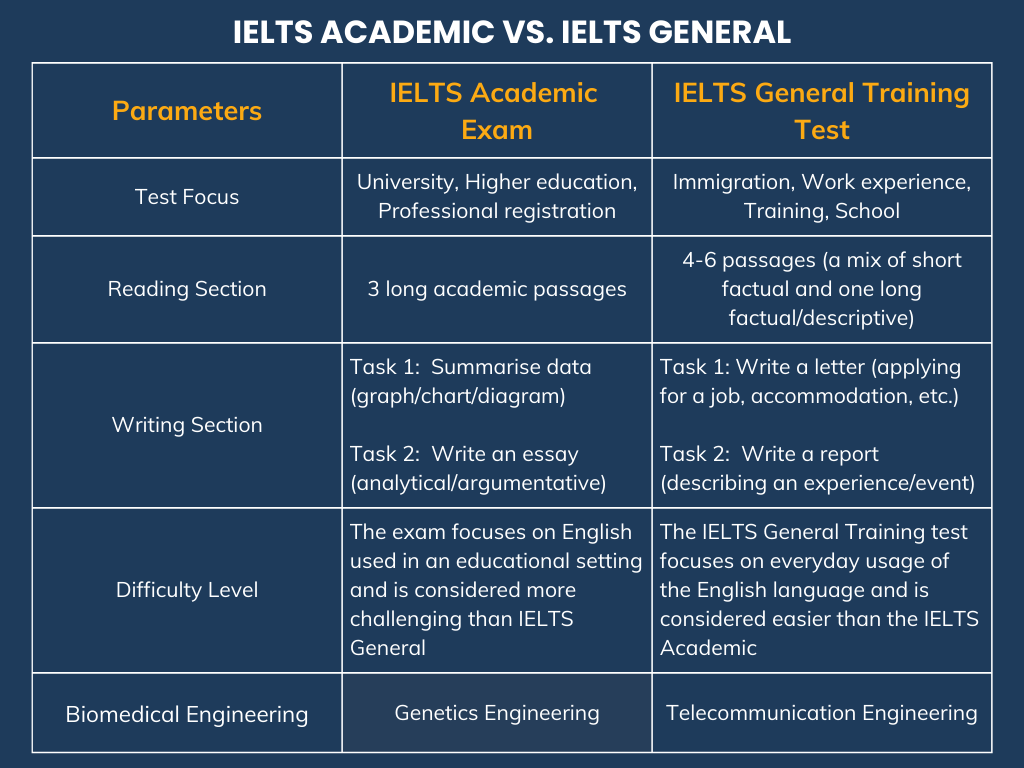
The reading section shows one of the clearest differences between IELTS Academic and General Training tests. Both tests give you 60 minutes and have 40 questions. However, they’re quite different in their content, structure, and what they aim to test.
Passage Types: Academic texts vs everyday materials
Each test version has its own purpose that shapes what you read:
IELTS Academic Reading has three long academic passages of about the same length. These come from books, journals, magazines, and newspapers. You’ll find topics ranging from science to history. The texts can be descriptive and factual or analytical and discussion-based. They often use technical terms and sometimes include diagrams, graphs, or illustrations.
IELTS General Training Reading gives you a more varied mix with shorter texts spread across three sections:
- Section 1: Two or three short factual texts about everyday life (advertisements, brochures, notices)
- Section 2: Two short, work-related factual texts (job descriptions, company policies, guidelines)
- Section 3: One longer, more complex text on a topic that interests most people
The main difference lies in how you’ll use these skills. Academic passages test if you can understand complex university-level content – perfect for undergraduate or postgraduate studies. General Training passages check how well you can handle written English you’d see in daily life and work.
Question Types: Similarities and minor differences
Both IELTS Reading tests use almost the same question types. Research shows there are 14-15 common question formats in both versions, such as:
- Matching headings/information/features
- True/False/Not Given or Yes/No/Not Given
- Multiple choice questions
- Sentence completion
- Summary/table/flowchart completion
- Short answer questions
The Academic test has just one unique question type—Global multiple-choice. This means you can use similar strategies for both tests.
Both tests require you to write answers on the answer sheet within 60 minutes. The test doesn’t give extra time to transfer answers. Computer-based tests show passages on the left side and questions on the right.
Reading difficulty: Which IELTS is easier?
Your background and reading habits play a big role in which test you’ll find easier. Most test-takers say the General Training Reading test feels more available because:
- Passage complexity: Academic texts use more specialized vocabulary and complex arguments. You need stronger comprehension skills.
- Scoring differences: Both tests have 40 questions, but General Training needs more correct answers for the same band score.
- Practical familiarity: You probably see advertisements, guidelines, and notices more often than academic journals or research papers.
Don’t take either test lightly. You need strong reading comprehension, skimming, and scanning skills for both. The General Training test gets harder as you go, and Section 3 can be just as challenging as Academic passages.
The best test for you lines up with your goals—Academic for university or General Training for immigration and work—rather than which one might give you a slightly better score.
Writing Section: Task Types and Expectations
The writing part shows one of the biggest differences between IELTS Academic and General Training tests, particularly in Task 1. Both versions keep the same two-task format and timing, but their content and what they ask for are quite different based on their purposes.
Task 1: Report vs Letter writing
The main difference between academic and general IELTS shows up in Task 1:
IELTS Academic Task 1 asks you to look at and explain visual information like charts, graphs, tables, or diagrams. You need to write a formal 150-word report that sums up key trends, compares data, and describes important features. This checks if you can understand and explain data you’d see in academic settings.
IELTS General Training Task 1 takes a completely different path. You’ll write a letter to respond to a given situation. Your letter could be formal, semi-formal, or casual depending on who you’re writing to. You might need to ask for something, explain something, or share your thoughts. This task checks how well you can communicate in everyday situations, unlike the Academic version.
Both tasks need at least 150 words and should take about 20 minutes to complete.
Task 2: Essay similarities and differences
Task 2 looks more alike in both test versions:
- You write a formal essay of at least 250 words
- You get 40 minutes to finish
- The marking criteria and scoring weight stay the same (66% of total writing marks)
- The scoring areas are similar: Task Response (25%), Coherence and Cohesion (25%), Vocabulary (25%), and Grammar (25%)
All the same, there are clear differences:
IELTS General Training essays usually talk about everyday topics like family, education, society, or entertainment. Most test-takers find these topics easier to handle. Academic essays often deal with more complex subjects that need deeper analysis and a more formal approach.
Tone and structure: Formal vs informal writing
The tone you should use changes by a lot between test versions:
Academic Writing needs formal language in both tasks. You should avoid contractions (write “cannot” not “can’t”), stay objective, use fewer personal pronouns, and pick academic vocabulary. Your writing should stick to facts and avoid emotional language.
General Training Writing lets you be more flexible, especially in Task 1. Your tone depends on who will read your letter:
- Letters to friends can use casual language with contractions and everyday expressions
- Letters to professionals need formal language even for simple topics
- Your greeting and closing should match how formal you need to be (like “Dear Sir/Madam” vs “Dear [First Name]”)
Getting these differences right is vital since using the wrong level of formality can really hurt your Task Achievement score, which makes up 25% of your writing marks.
Becoming skilled at handling academic and general IELTS writing tasks means more than knowing what to write. You need to adapt your style, structure, and tone to fit what each test version wants.
Scoring System and Difficulty Level
Getting to know the IELTS scoring system plays a significant role in test preparation, whatever version you choose. IELTS Academic and General Training use similar scoring mechanisms, though they differ slightly in difficulty level and score conversion.
9-band scoring: Same for both tests
The IELTS uses a standardized 9-band scale that evaluates English language proficiency across all test components. Band scores range from 0 (did not attempt the test) to 9 (expert user). Each band shows a distinct proficiency level:
- Band 9: Expert user with full operational command
- Band 8: Very good user with only occasional inaccuracies
- Band 7: Good user with operational command despite occasional inaccuracies
- Band 6: Competent user with effective command despite some errors
- Band 5: Modest user with partial command, likely to make many mistakes
The system calculates your overall IELTS score by averaging the four individual section scores (Listening, Reading, Writing, and Speaking) and rounds it to the nearest half or whole band. Your average ending in .25 rounds up to the next half band (e.g., 6.25 becomes 6.5), and if it ends in .75, it goes up to the next whole band (e.g., 6.75 becomes 7.0).
Task weightage and marking criteria
Both test versions share similar assessment criteria. Examiners review four dimensions in the Writing section with equal weightage (25% each):
- Task achievement (Task 1) or task response (Task 2)
- Coherence and cohesion
- Lexical resource
- Grammatical range and accuracy
The Speaking test assessment uses four equally weighted criteria:
- Fluency and coherence
- Lexical resource
- Grammatical range and accuracy
- Pronunciation
Task 2 in the Writing section carries more weight than Task 1 in the final score calculation. This makes the essay portion a significant part that needs adequate time and effort.
Which IELTS is easier to score higher in?
Many test-takers find the General Training version a bit easier to score higher in. The Reading section’s scoring conversion makes the main difference. The General Training Reading test needs fewer correct answers to achieve the same band score as the Academic version. To name just one example, see how a band score of 6.5 needs 27-29 correct answers in General Training compared to 30-32 in Academic.
The IELTS General test seems more available to most people since it tests everyday English instead of specialized academic language. This doesn’t mean General Training offers an easy path—it just arranges with different language needs and contexts.
Your background, preparation, and comfort with different types of material determine which version feels “easier”. Both tests need full preparation and strong English language skills to achieve high band scores.
Choosing the Right Test Based on Your Goals
Your future plans and goals determine which IELTS test you should take. The right version will save you time, money and help you avoid frustration.
Which IELTS should I take for Masters?
IELTS Academic is the clear choice for higher education. Universities and colleges in English-speaking countries need the Academic version for undergraduate and postgraduate admissions, including Master’s programs. This test shows you can handle university-level reading materials and writing tasks.
Top universities have strict rules about test scores. To name just one example, King’s College London accepts IELTS Academic scores that are valid within two years of your program’s start date. Universities can’t use IELTS General Training for academic admissions because it doesn’t test the language skills needed for success at university.
IELTS for immigration and work
IELTS General Training works best for migration purposes. Yes, it is the only English test that Australia, Canada, New Zealand, and UK governments trust for immigration. Each country has its own score requirements:
- Australia: Minimum IELTS score of 6.0 for immigration
- Canada: Minimum score of 6.0 for migration, 7.0 for some professional programs
- New Zealand: Score requirement of 6.5 for immigration
- UK: Requirements vary from 4.0 to 7.0 depending on visa type
The General Training test suits you best if you’re applying for permanent residency, but some professional registrations might need Academic scores.
Academic vs General: What do universities and visa offices prefer?
Immigration authorities usually accept IELTS General Training. Universities only take IELTS Academic.
UKVI (UK Visas and Immigration) has different requirements based on visa types. Degree-level study needs IELTS Academic with a minimum score of 5.5 in each component. Below-degree level studies need IELTS General Training with at least 4.0 in each component.
Some professional bodies have special rules. To name just one example, Australia’s Nursing & Midwifery Accreditation Council needs IELTS Academic scores even for migration. You should check what your target institution or immigration authority needs before booking your test.
Comparison Table
| Aspect | IELTS Academic | IELTS General Training |
| Main Goal | University admission and professional registration | Immigration and work purposes |
| Target Audience | – University students (undergraduate/postgraduate)- Professional registration seekers (medicine, nursing, engineering)- Students aiming for higher education | – Immigration applicants- Work visa seekers- Secondary education students- Vocational training candidates |
| Listening Test | Similar format: 30 minutes + 10 minutes transfer time | Similar format: 30 minutes + 10 minutes transfer time |
| Speaking Test | Similar format: 11-14 minutes, face-to-face interview | Similar format: 11-14 minutes, face-to-face interview |
| Reading Content | Three long academic texts from books, journals, and newspapers | Three sections:- Social survival texts- Workplace documents- General interest texts |
| Writing Task 1 | 150-word report that analyzes visual information (graphs, charts, diagrams) | 150-word letter (formal, semi-formal, or informal) |
| Writing Task 2 | Formal essay on complex topics that needs analytical thinking | Essay on everyday topics with a flexible approach |
| Language Level | More formal, academic vocabulary with complex arguments | More practical, everyday English usage |
| Test Duration | 2 hours 45 minutes (excluding speaking) | 2 hours 45 minutes (excluding speaking) |
| Scoring System | 9-band scale (similar scoring criteria) | 9-band scale (similar scoring criteria) |
| Relative Difficulty | People find it more challenging due to academic content | More available due to practical content |
Conclusion
Your choice between IELTS Academic and General Training ends up depending on your specific goals and dreams. This piece takes a closer look at the main differences between these two test versions and their unique purposes.
Academic tests open doors to higher education and professional registration in English-speaking countries. General Training tests help with immigration and job opportunities abroad. Both tests have similar Listening and Speaking sections. Their Reading and Writing parts differ by a lot to meet different real-life language needs.
Your choice should line up with what your target institution or immigration authority wants. Students going for undergraduate or postgraduate education must take the Academic version. Universities won’t accept General Training scores to admit students. Most immigration departments ask for General Training results, except when you need certain professional registrations.
The 9-band scoring system and test duration stay the same for both versions. Test-takers often find General Training more available because of its practical content and familiar settings. But you shouldn’t take preparation lightly for either version.
Your success in international education or migration depends by a lot on picking the right test. Research what your destination country, institution, or professional body needs before you book your IELTS exam. Understanding which IELTS version fits your future plans will save you time, money, and stress while you work toward your goals.
FAQs
Q1. What is the main difference between IELTS Academic and General Training?
The primary difference lies in their purpose and content. IELTS Academic is designed for university admissions and professional registration, featuring more complex academic texts and tasks. IELTS General Training is geared towards immigration and work purposes, with content focused on everyday and workplace English.
Q2. Which IELTS test should I take for a Master’s degree?
For a Master’s degree or any higher education program, you should take the IELTS Academic test. Universities specifically require the Academic version to assess your ability to handle university-level reading materials and writing assignments.
Q3. Are the Listening and Speaking sections the same in both IELTS versions?
Yes, the Listening and Speaking sections are identical in both IELTS Academic and General Training tests. They assess the same skills and follow the same format, regardless of which version you choose.
Q4. How long does each IELTS test take?
Both IELTS Academic and General Training tests have the same duration. The total test time is approximately 2 hours and 45 minutes, excluding the Speaking test which is scheduled separately and lasts 11-14 minutes.
Q5. Is one version of IELTS easier than the other?
While many test-takers find the General Training version slightly more accessible due to its practical content, neither test should be considered “easy.” The difficulty level depends on your background and preparation. Both versions require strong English language skills to achieve high band scores.