Beyond USA & Canada: Where Indian Students Are Going Now
The old playbook is broken. Visa rejections, soaring costs, and tighter immigration rules are sending India’s brightest students to destinations their parents never considered and they’re thriving.
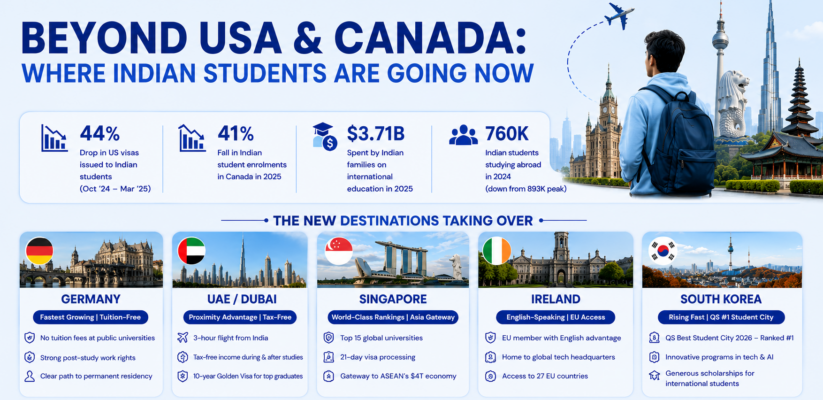
44% Drop in US visas issued to Indian students (Oct ’24 – Mar ’25)
41% Fall in Indian student enrolments in Canada in 2025
$3.71B Spent by Indian families on international education in 2025
760K Indian students studying abroad in 2024 (down from 893K peak)
For two decades, the script was simple. Study hard, crack the GRE or GMAT, apply to American or Canadian universities, and build a life abroad. Millions of Indian families wrote their financial futures around this single narrative. But in 2026, that script has been torn up — not by choice, but by circumstance.
US student visa issuances to Indian applicants dropped 44% between October 2024 and March 2025. Canada, which at its peak was absorbing the largest number of Indian students of any country, slashed enrolments by 41% in 2025 after ending its fast-track Student Direct Stream. The H-1B remains a lottery. The rupee has depreciated nearly 30% against the dollar since 2015. And across the political landscape of the traditional “Big Four” destinations — USA, Canada, UK, Australia — international students are increasingly being treated as a policy problem rather than an asset.
So where are Indian students going? The answer is more interesting — and more strategic — than most people expect.
Why the Old Destinations Are Losing Ground
The shift isn’t just about visa rejections, though those are real and painful. It’s about a fundamental recalculation of risk and return. The cost of a mid-tier American university degree has grown faster than US inflation for seven straight years. Australia’s cost of living now erodes savings faster than tuition does. The UK’s post-study work visa faces constant political review. And Indian families spent $3.71 billion on international education in 2025 — a 31% increase from 2018 — meaning the stakes have never been higher, and the tolerance for uncertainty has never been lower.
What’s emerging in place of the old instinct is something more sophisticated: a generation of students and families doing genuine cost-benefit analysis, weighing visa stability, post-graduation work rights, quality of education, proximity to India, and long-term residency pathways — not just chasing brand names. A good study abroad consultant can make all the difference in navigating these new options.
The families making these moves aren’t settling. They’re calculating — and they’re doing better math than the ones still chasing brand-name destinations. UniGo Education, Study Abroad Analysis 2026
The New Destinations Taking Over
Germany
Fastest Growing, Tuition-Free
With over 50,000 Indian students now enrolled, Germany has become the headline alternative destination. The reason is almost embarrassingly simple: public universities charge no tuition fees to international students. Zero. A master’s degree from TU Munich or RWTH Aachen — universities that rank comfortably among the world’s best in engineering and technology — costs little more than a semester administration fee of a few hundred euros. Add a stable student visa regime, strong post-graduation work rights, and a clear pathway to permanent residency, and Germany offers something the Big Four can no longer reliably promise: certainty. Most German universities accept IELTS or TOEFL scores for English-taught programmes.
UAE / Dubai
Proximity Advantage, Tax-Free
Indian students now make up 42% of the international cohort in Dubai’s private higher education institutions, with enrolments rising from 5,850 in 2023 to 6,507 in 2025. Dubai hosts branch campuses of the University of Birmingham, Heriot-Watt, and the University of Wollongong, among others. It’s a three-hour flight from most Indian cities. There’s no culture shock — the food, the community, the familiarity is all there. And the tax-free income during internships and post-graduation work is a financial advantage that compounds. The UAE’s Golden Visa for top graduates (10-year residence) adds a long-term layer that simply didn’t exist three years ago.
Singapore
World-Class Rankings, Asia Gateway
The number of Indian students in Singapore grew from 2,850 in 2023 to 3,250 in 2025 — a deliberate, quality-driven increase. NUS and NTU are consistently ranked among the top 15 universities in the world. Singapore processes student visas in roughly 21 days, ranks #6 on the Global Peace Index, and sits five hours from Delhi. For students targeting AI, data analytics, and finance, Singapore offers something the Big Four often don’t: direct proximity to ASEAN’s $4 trillion economy — the fastest-growing economic bloc in the world. Admissions typically require a strong IELTS or GRE score.
Ireland
English-Speaking, EU Access
Ireland has quietly built one of the most compelling propositions for Indian tech and business graduates. As the European headquarters for Google, Meta, Apple, and dozens of other global tech firms, Ireland offers post-graduation access to a jobs market that rivals Silicon Valley for tech roles — with the added advantage of being an English-speaking EU member state. A degree from University College Dublin or Trinity College Dublin now opens doors across 27 European countries. Visa stability here has been notably consistent even as the UK and US tighten. Irish universities typically require IELTS or PTE scores as part of the application.
South Korea
Rising FastQS #1, Student City
In the QS Best Student Cities 2026 rankings, Seoul took the top spot — the first time ever that both the #1 and #2 positions (Seoul and Tokyo) went to Asian cities. South Korea is actively courting international students with generous government scholarships (the GKS scholarship covers full tuition, living costs, and a monthly stipend), world-class universities in KAIST and Seoul National University, and a booming tech and semiconductor industry hungry for global talent. For Indian students interested in engineering and emerging tech, South Korea is no longer a stretch — it’s a smart play.
What Smart Families Are Prioritising Now
Visa Stability
Predictable, transparent visa processes with low rejection rates. Germany and Singapore score highest here in 2026.
Post-Study Work Rights
A clear, legally defined window to work after graduation — not subject to annual political review or lottery systems.
Real Cost of Living
Total cost including accommodation, food, and transport — not just tuition. Germany and UAE score far better than Australia or the US.
Proximity to India
Shorter flights mean lower travel costs, easier family visits, and faster repatriation if plans change. UAE and Singapore win on this metric.
Context Worth Knowing
In 2024, two out of every three Indian students studying abroad were in the traditional “Big Four” — USA, Canada, UK, Australia. That concentration is now breaking apart rapidly, as visa tightening in all four countries simultaneously pushes students toward markets that were previously considered secondary but are increasingly competitive in quality, career outcomes, and value.
Is This a Downgrade? Absolutely Not.
The instinctive reaction from older generations – that choosing Germany over Georgetown or Singapore over Stanford is settling for less – is being dismantled by data. NUS Singapore and TU Munich both sit comfortably in the global top 50 across multiple subject rankings. Irish universities place graduates directly into European roles at companies that define the global tech economy. Seoul’s universities feed one of the world’s most dynamic semiconductor and consumer electronics industries.
The shift happening now isn’t a retreat. It’s a recalibration — from chasing the prestige of a zip code to investing in the quality of an outcome. The Indian students making these moves in 2026 aren’t going to Plan B. In many cases, they’re going to a better Plan A than the one their predecessors were sold.
The map of global opportunity has expanded. The old centres haven’t disappeared — but they’ve been joined by new ones, and the students finding their way to those new centres first will have an advantage that compounds. The world has more doors now than it did five years ago. The question for Indian students in 2026 isn’t which country is best in the abstract. It’s which door is open, which leads where you want to go, and whether you can afford to wait for the ones that used to feel certain. The right study abroad guidance — and the right test score to back your application — can be the difference between waiting and going.
FAQs
1 Why are Indian students moving away from countries like the USA and Canada?
Indian students are shifting due to rising visa rejections, increasing education costs, stricter immigration policies, and uncertainty around post-study work opportunities.
2 Which countries are becoming the best alternatives for Indian students in 2026?
Germany, UAE (Dubai), Singapore, Ireland, and South Korea are emerging as the top alternatives because of affordable education, stable visa systems, and strong career opportunities.
3 Why is Germany one of the fastest-growing study destinations?
Germany offers tuition-free public universities, globally ranked institutions, excellent engineering programmes, and strong post-study work opportunities.
4 What factors should students consider before choosing a study abroad destination?
Students should focus on visa stability, total cost of living, post-study work rights, university quality, and long-term career opportunities instead of only brand-name countries.
5 Are these new study destinations better than traditional options?
Many of these newer destinations now offer world-class education, better affordability, safer immigration pathways, and strong global career outcomes, making them highly competitive alternatives.